Use Completed Jobs to Improve Your Next HVAC Estimate
Past jobs can help an estimator see what the next project may require. The useful input is a group of comparable jobs with a clear scope and consistent cost definitions. A dashboard cannot repair missing labor, unrecorded change orders, or a comparison between fundamentally different installations.
Start with one estimating question
Choose a specific question: Are replacement installations exceeding planned labor? Are access arrangements adding time? Are quoted materials missing necessary accessories? Each question needs different information. Combining them into a single “estimate accuracy” score can conceal the reason a job changed.
Separate an estimating omission from a customer-authorized addition, an unexpected site condition, rework, or a purchasing price change. All can affect the final result, but they call for different responses. A blanket labor increase will not correct incomplete equipment identification.
Define the comparison point. An original proposal, a revised authorized scope, and a final invoice are different records. Retain the original estimate and its assumptions so the team can explain the change rather than overwrite the evidence.
Make the units comparable
Decide whether labor means technician-hours, crew-hours, or elapsed time. Two technicians working four hours contribute eight technician-hours; that is different from a four-hour appointment. Include travel, preparation, supervision, and other time according to an explicit costing policy.
Apply the same discipline to dollars. Compare estimated and actual costs on the same basis, including the treatment of freight, tax, returns, subcontractors, and allocated expenses. Revenue variance does not explain cost variance when the selling price also changed.
Group work by relevant conditions, such as equipment type, installation scope, access, and occupied-site constraints. Start with groups the team can explain. Very small groups can produce unstable conclusions; a large mixed group can hide important differences.
See how the weighting changes the answer
Consider two invented jobs measured in technician-hours. Neither includes an authorized scope change.
| Job | Estimated hours | Actual hours | Overrun |
|---|---|---|---|
| Small job | 2 | 4 | 2 hours; 100% |
| Larger job | 18 | 20 | 2 hours; about 11.1% |
The simple average of the two percentage overruns is about 55.6%. That gives each job equal weight. The combined total is twenty estimated hours and twenty-four actual hours, so the pooled overrun is 20%: four extra hours divided by twenty estimated hours.
Both calculations describe these observations, but they answer different questions. Neither proves that all future estimates need a 20% or 55.6% increase. The same two-hour omission might explain both jobs, in which case correcting that omitted task may be more useful than multiplying every estimate.
Investigate the spread, not just the average
Look at individual results alongside a summary. A few severe exceptions can move an average substantially. NIST’s discussion of measures of location explains how skew and extreme observations affect the mean and why the median can provide a different view of a typical value.
For estimating, keep unusual jobs visible and investigate them. Do not delete a difficult project merely because it makes the report look worse. Identify whether its conditions are part of the work you expect to accept again.
A useful job note says “additional approved access work required” or “accessory omitted from original takeoff,” with supporting detail. “Bad estimate” does not identify a repairable step.
Separate repeated bias from an isolated exception
If comparable jobs repeatedly require more of the same task than the estimate allows, the baseline assumption deserves review. If most jobs are close and one has an unusual access problem, the first question is whether that condition should have been identified and quoted separately. The response may be a different allowance, a site-survey question, or a clearer exclusion rather than a change to every task.
Keep dollars and quantities available together. Material spending can rise because the same items cost more, because more items were needed, or because the selected items changed. Labor spending can rise because hours increased, cost per hour changed, or both. A final total alone cannot distinguish these explanations. Reconcile the component that changed before revising the estimating method.
Test a change on later work
Revise one assumption or checklist item, then evaluate it on later comparable jobs. Do not use final-job knowledge to reconstruct a supposedly accurate original estimate. That tests hindsight rather than the information available when quoting.
Review error in both directions, the number and type of jobs, and any change in scope or cost conditions. A small trial can reveal a problem worth investigating; it does not establish a permanent industry benchmark.
For equipment and material inputs, give Mar-Hy the exact proposed system, accessories, quantities, and required timing. Confirm the current quote and availability assumptions before carrying them into a customer proposal.
PROSTOCK AT MAR-HY
PROSTOCK PROFESSIONAL QUALITY HVAC PARTS AND SUPPLIES
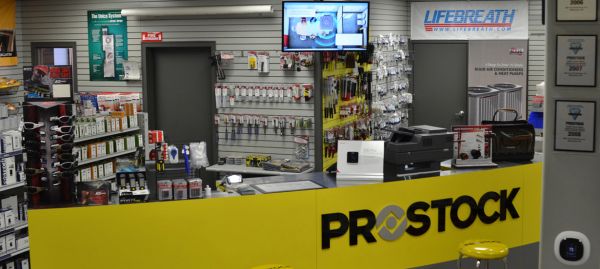
Support for the next service call.
Mar-Hy Distributors adopted the Prostock concept to enhance our support of local HVAC contractors. Since opening our Prostock store, we have received positive feedback from contractors on how they have improved response time to their customers. Our HVAC contractors have been able to stay ahead of the competition with access to our extensive inventory of Prostock Parts.
Quality parts. Contractor support.
Our Prostock replacement parts department is committed to improving the business of our HVAC contractors by providing quality services, competitive pricing, and products and supplies that earn customer trust and build lifetime customer satisfaction. We value our contractors and will continue to provide top of the line service for all of your HVAC needs.
Our team at Mar-Hy Distributors would like to thank you for your business.
