Map a Commercial HVAC Proposal to the Owner’s Acceptance Requirements
A commercial proposal should let the owner understand what will be delivered, how work interfaces are handled, and what evidence supports acceptance. Organize the offer around those decisions. A polished cover and a single total cannot explain an incomplete scope.
Begin with the owner’s actual requirements
Review the request, drawings, specifications, site information, operating constraints, and relevant clarifications. Identify the document versions used to prepare the proposal and any unresolved conflicts.
State the project purpose in practical terms: the areas or functions to be served, the agreed work, and the constraints that shape delivery. Do not substitute a generic claim of improved comfort or sustainability for the actual acceptance requirements.
If design responsibility, performance criteria, or a major site condition is unresolved, identify it before making an unconditional promise. Have the responsible qualified people establish the basis.
Create a requirements-to-scope map
| Requirement | Proposed scope | Acceptance evidence |
|---|---|---|
| Equipment and application | Exact combination, accessories, design basis, and relevant limits. | Applicable approved documents and verified installed identity. |
| Building operation | Accepted interruption windows, access, and any reviewed temporary arrangement. | Agreed coordination and actual completion status. |
| Trade interfaces | Responsibility for controls, electrical, structural, and other relevant work. | Resolved interfaces and applicable checks. |
| Verification | Required tests, conditions, responsible people, and documentation. | Accepted results and disposition of unresolved items. |
| Handoff | Operating explanation, records, service route, and agreed aftercare. | Delivered information and named remaining responsibilities. |
The table is a proposed communication method, not a universal specification. Replace the examples with the actual project’s requirements and review responsibilities.
Make exclusions visible at the relevant interface
If electrical work is excluded, say which work is excluded and who must arrange it. A general exclusions paragraph at the end may not help the buyer understand that another contract is needed before startup.
Use the same discipline for permits, design, roof work, lifting, controls integration, testing, removal, or another relevant interface. Do not imply that all excluded work is optional simply because it is outside this contractor’s price.
Have the appropriate commercial and legal reviewers align the proposal with the actual procurement and contract requirements. A standard qualification that conflicts with the buyer’s required terms may not protect the company as assumed.
Compare prices on an equivalent scope
Consider two invented offers. Offer A is $40,000 but excludes a required electrical scope modeled separately at $3,000. Offer B is $42,000 and includes that same electrical scope. On the limited assumptions, A’s combined total is $43,000, which is $1,000 above B.
These are teaching figures, not local prices or proof that the offers are otherwise equivalent. Taxes, qualifications, performance, schedule, risk, and other terms still need review.
The example shows why the lowest headline number may not be the lowest comparable scope. Reconcile the included work before presenting a price comparison or a good-better-best option set.
Describe schedule dependencies
Identify what must be confirmed before the schedule is committed: accepted design and scope, equipment readiness, access, permits where applicable, other trades, qualified resources, and suitable verification conditions.
Separate a planning duration from a guaranteed calendar date. Explain the assumptions and the process for a changed prerequisite. Avoid promising an interruption window that depends on unconfirmed material or third-party availability.
Include the time and responsibility for verification and handoff. Physical installation being complete does not necessarily mean every acceptance item is complete.
Define what verification will establish
DOE’s commissioning-process guidance for federal facilities connects planning, requirements, testing, documentation, and completion. Use the actual project’s commissioning and acceptance scope; the federal guidance is not automatically the contract for another commercial job.
State which checks are included, who performs and reviews them, which conditions are needed, and how open findings are handled. Do not call a report “commissioning” merely because it contains startup values.
Keep jurisdictional inspections, manufacturer startup records, and project acceptance requirements distinct where applicable. A single “passed” label can obscure which result has actually been obtained.
Separate warranty and continuing service
Describe applicable product warranties, contractor obligations, and any separately proposed service agreement accurately. Do not imply that one manufacturer’s warranty covers every labor, access, diagnostic, or maintenance cost.
Identify the service contact and the process for unresolved or later concerns. An owner should understand who receives the first request rather than have to determine which trade might be responsible before reporting a problem.
Finish with a reviewable decision
Make scope, total and basis, terms, assumptions, exceptions, authorization method, and validity clear. Preserve the version accepted so later changes can be distinguished from the original commitment.
For the equipment and material inputs, provide Mar-Hy the exact proposed system, accessories, quantities, and timing. Confirm current documentation and quote terms before incorporating them into the owner’s proposal.
PROSTOCK AT MAR-HY
PROSTOCK PROFESSIONAL QUALITY HVAC PARTS AND SUPPLIES
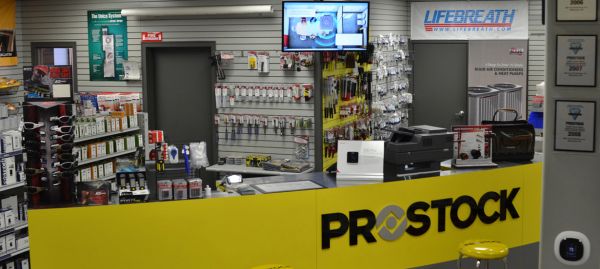
Support for the next service call.
Mar-Hy Distributors adopted the Prostock concept to enhance our support of local HVAC contractors. Since opening our Prostock store, we have received positive feedback from contractors on how they have improved response time to their customers. Our HVAC contractors have been able to stay ahead of the competition with access to our extensive inventory of Prostock Parts.
Quality parts. Contractor support.
Our Prostock replacement parts department is committed to improving the business of our HVAC contractors by providing quality services, competitive pricing, and products and supplies that earn customer trust and build lifetime customer satisfaction. We value our contractors and will continue to provide top of the line service for all of your HVAC needs.
Our team at Mar-Hy Distributors would like to thank you for your business.


