
Explain HVAC Carbon Claims by Showing What Was Counted
A heat pump can change a building’s energy use and emissions, but “carbon neutral” is a much broader claim than “uses electricity.” Before describing an HVAC project in environmental terms, identify the emissions included, the comparison being made, the calculation method, and the evidence supporting the result.
Separate efficiency, energy, and emissions
Efficiency describes a relationship between useful output and input under defined conditions. Energy use depends on the load, weather, controls, installation, and operation. Emissions add another layer: the source of the energy and the accounting method used.
ENERGY STAR explains that an air-source heat pump transfers heat rather than producing it through fuel combustion. That mechanism is why useful heat output can exceed the electrical energy input. It does not mean the electricity has no associated emissions or that every installation has the same annual performance.
A model with a higher rating is not a complete carbon calculation. Compare equipment capable of serving the actual building, account for the operating conditions, and distinguish rated performance from a site-specific estimate or measured result.
Define the accounting boundary
EPA’s inventory guidance distinguishes direct emissions from owned or controlled sources, such as fuel combustion, from indirect emissions associated with purchased electricity and other energy. Its resources also address fugitive refrigerant emissions.
For a project comparison, state whether the analysis includes operating energy only, refrigerant releases, equipment manufacture, installation, replacement, and end-of-life activity. These are different boundaries. A comparison that excludes equipment manufacture cannot establish a complete lifecycle result.
State the period as well. A first-year estimate, a typical-year model, and a multi-year lifecycle comparison answer different questions. Keep assumptions about equipment life, maintenance, grid emissions, and replacement visible instead of combining them into an unexplained percentage.
For reporting, also state whose emissions are being described. A contractor’s fleet and premises, a customer’s building operation, and a product’s lifecycle are different subjects. Installing a lower-emission system at a customer site does not automatically establish that the contractor’s own business is carbon neutral.
Work through a simple operating example
Consider invented heating options delivering 30,000 kWh of useful heat over a defined period. Suppose Option A consumes 33,333 kWh of fuel energy at an assumed 90% conversion efficiency. Suppose Option B consumes 10,000 kWh of electricity at an assumed seasonal output-to-input ratio of three.
Now assign hypothetical emissions factors solely to illustrate the arithmetic: 0.20 kg CO2e per kWh of fuel energy and 0.30 kg CO2e per kWh of electricity. Option A’s modeled operating emissions are approximately 6,667 kg CO2e. Option B’s are 3,000 kg CO2e.
Those are not local factors, product claims, or Mar-Hy results. They exclude other emissions and are deliberately simplified. The example shows that the calculation needs both energy use and a suitable emissions factor. It does not justify applying the resulting difference to another home or fuel supply.
Changing the electricity factor, seasonal performance, heating load, or fuel assumptions changes the comparison. Use the appropriate current method and source data for a real proposal, with qualified review where needed.
The same figures also reveal a break-even assumption in this simplified operating model. Dividing approximately 6,667 kg CO2e by 10,000 kWh gives an electricity factor of about 0.667 kg CO2e per kWh. At that factor, the modeled options have approximately equal operating emissions. Below it, Option B has lower modeled emissions; above it, the comparison reverses under these assumptions.
This is an illustration of sensitivity, not a decision threshold for an actual project. A real model may need additional energy uses, fuel-supply effects, seasonal operating modes, and a different accounting method. Showing which assumption controls the result is more informative than presenting a single unexplained total.
Keep refrigerant impact separate from energy performance
A lower global warming potential concerns the effect of a released quantity of refrigerant under a stated comparison basis. It does not by itself tell you how much refrigerant will be released or how much electricity a system will consume.
A complete comparison needs the relevant refrigerant identity, charge, release assumptions or records, and end-of-life treatment, alongside energy use. Avoid presenting a reduction in refrigerant GWP as an equal reduction in the whole system’s emissions.
Similarly, eliminating on-site combustion does not mean every associated emission disappears. Explain the changed source clearly: the project may replace direct fuel use with electricity whose generation is accounted for elsewhere.
Use claims that match the evidence
| Claim | Question to resolve | More useful explanation |
|---|---|---|
| Lower operating emissions | Compared with what, over which period, using which factors? | State the modeled boundary, baseline, and assumptions. |
| Lower-GWP refrigerant | Which refrigerants and comparison basis? | Keep the refrigerant property distinct from total system impact. |
| Carbon neutral | Which emissions are counted and how are remaining emissions addressed? | Obtain appropriate substantiation and review before using the broad claim. |
FTC’s Green Guides summary cautions against broad, unqualified environmental-benefit claims and addresses substantiation for carbon offsets. A specific, supported statement is more informative than an unexplained green label.
Connect the explanation to the actual project
Keep the comfort requirement, application, installation quality, and operating plan central to the decision. An emissions comparison should accompany a workable system proposal, not replace its design.
Ask Mar-Hy for the exact equipment performance documents needed for the comparison. Have the responsible project team establish the building assumptions and emissions method, and label estimates as estimates when explaining them to the customer.
PROSTOCK AT MAR-HY
PROSTOCK PROFESSIONAL QUALITY HVAC PARTS AND SUPPLIES
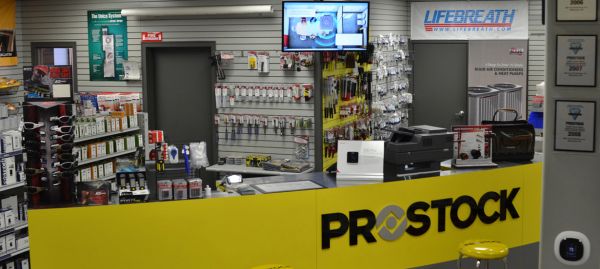
Support for the next service call.
Mar-Hy Distributors adopted the Prostock concept to enhance our support of local HVAC contractors. Since opening our Prostock store, we have received positive feedback from contractors on how they have improved response time to their customers. Our HVAC contractors have been able to stay ahead of the competition with access to our extensive inventory of Prostock Parts.
Quality parts. Contractor support.
Our Prostock replacement parts department is committed to improving the business of our HVAC contractors by providing quality services, competitive pricing, and products and supplies that earn customer trust and build lifetime customer satisfaction. We value our contractors and will continue to provide top of the line service for all of your HVAC needs.
Our team at Mar-Hy Distributors would like to thank you for your business.


